Of Amazing Things / cursos / estetica-belleza
Cosmetology Courses in Miami: Requirements and Options
How to compare cosmetology, nail, and facial-care programs before pursuing a Florida license
If you are researching cosmetology courses in Miami, the first decision is not which school has the most attractive advertisement. It is which credential you want and whether the program matches Florida’s licensing rules. Cosmetology, nail work, facial care, and makeup are related fields, but they are not automatically the same professional pathway.
This guide brings together official requirements and several technical-education options listed in public Miami-Dade directories. It is not a ranking of schools and it does not promise current seats, prices, or start dates. Confirm every enrollment detail with the school and with the Florida DBPR before paying a deposit.
Which Florida license are you pursuing?
A cosmetologist license is the broadest route. It prepares students for hair services and includes training related to nails, skin, chemistry, safety, and client care. Florida law says that an applicant seeking licensure by examination through Florida education must be at least 16 or have a high school diploma, pay the applicable fees, and complete at least 1,200 hours of training in an approved school or program. The controlling reference is Florida Statutes section 477.019.
The current DBPR checklist also points to an examination process and an initial HIV/AIDS course of at least four hours completed within the period specified by the agency. A school can prepare you and certify education, but the state issues the license. Completing classes alone does not replace the application and examination steps.
Cosmetology, nails, and facial care are different paths
If your main interest is esthetics, ask whether a program leads to a full cosmetologist license or to a specialty registration. Florida law describes specialty registrations with different training amounts: 180 hours for some specialties, 220 for others, and 400 for a combined registration, depending on the practice and applicable rules. Review the official wording in section 477.0201.
- Cosmetology: the longer 1,200-hour program that prepares students for the cosmetologist examination.
- Nail specialty: focused on manicures and pedicures; it is not the same as a full cosmetology license.
- Facial specialty: focused on facial and skin-care services within Florida’s permitted scope; it does not replace the cosmetologist license.
- Makeup: may be offered as a standalone skills course, but it should not automatically be marketed as a state professional license.
Technical-school options in Miami-Dade
The Miami-Dade Career & Technical Education directory lists cosmetology in the Human Services area and connects the program with D.A. Dorsey Technical College, The English Center, Lindsey Hopkins Technical College, Miami Lakes Educational Center & Technical College, Robert Morgan Educational Center & Technical College, and South Dade Technical College. The directory is a useful starting point; it does not by itself confirm that a seat, schedule, or specific intake is currently available.
For a concrete example, The English Center from Miami-Dade Public Schools publishes a 1,200-hour program with laboratory practice, a counselor interview, and a basic-skills test within the first weeks. It also lists daytime and evening options. That is information published by the center, not a claim that it is the best fit for every student.
South Dade Technical College describes a 1,200-hour plan covering hair, chemistry, nails, facials, safety, and laboratory practice. Its page publishes costs and schedules that can change, so use them as questions to verify rather than as a guaranteed quote. Reviewing public technical colleges can be helpful because their admissions requirements and curriculum are usually described more directly than in a short advertisement.
What a serious program should teach
A complete program should be more than styling demonstrations. Florida’s career and technical education framework places cosmetology within Human Services and includes both technical and academic skills. Local programs commonly cover hair theory, cutting, color, chemical services, sanitation, disinfection, anatomy, chemistry, nails, facial care, customer service, and supervised practice.
Hands-on work matters because the job involves timing, product handling, contact with skin, and client safety. Ask how many hours are laboratory hours, which supplies are included, whether students work on models or members of the public under supervision, and how hours are recorded. Ask the school to explain which services fall within the scope of the license you plan to pursue.
How to compare schools before paying tuition
- Verify the program: request the school’s legal name and confirm that it is acceptable for Florida’s licensing process.
- Request the curriculum in writing: it should show hours, modules, practice, supplies, examinations, and attendance rules.
- Separate tuition from extras: ask about the kit, books, uniform, application fees, examination, HIV/AIDS course, and replacement supplies.
- Confirm the actual calendar: “day” or “evening” is not enough; ask for weekly hours and the absence-recovery policy.
- Ask about transfer credit: do not assume a school will automatically accept previous training.
- Review the outcome: ask how the program prepares students for the examination and what support exists after completion.
Costs, timing, and facts to verify
There is no single price for cosmetology school in Miami. The total can vary by public or private provider, residency, schedule, supplies, and fees. It is also risky to convert 1,200 hours into a fixed number of months: the calendar depends on weekly hours and attendance.
Before signing, ask for a current total-cost estimate. Confirm whether it includes a kit, practice products, uniform, enrollment, state examination, and HIV/AIDS course. If an advertisement says “guaranteed license,” treat that as a reason to ask more questions: a school can provide training and documentation, but examination and licensure remain part of the state process.
A practical way to get started
For someone still comparing schools, the safest order is simple: read DBPR’s requirements; visit two or three centers; compare hours, schedule, practice, and total cost; then reserve a seat. If your goal is mainly nails or facial care, compare the relevant specialty before paying for a full 1,200-hour program you may not use.
If you are also planning other education or professional steps in Miami, read our guide to where to learn English in Miami and our overview of the Florida real-estate license path. They are different fields, but the same rule applies: check the official source before making an education decision.
Frequently asked questions
Can I work as a cosmetologist as soon as I finish classes?
Not necessarily. You must complete the requirements, submit the application, pass the examination, and obtain the applicable authorization. Confirm the process directly with DBPR.
Is a nail license the same as a cosmetology license?
No. It is a specialty with its own education and scope. Florida law distinguishes specialty registration from a cosmetologist license.
Do online classes qualify me for a Florida license?
Do not assume they do. Cosmetology training includes practical hours and must satisfy Florida’s accepted conditions. Ask both the school and DBPR before enrolling.
Are there programs for people who work?
Some centers publish evening schedules or open-entry policies, but hours change. The right option depends on your availability and whether you can complete the required training.
Editorial limits: this article is informational and was reviewed against official sources consulted on August 25, 2026. It is not legal, regulatory, or academic advice. We did not verify each school’s current seats, prices, or teaching quality; confirm those details directly before paying.
Our Honest Take
The best sign of a cosmetology course is not a promise of a quick transformation. It is a clear explanation of hours, practical training, sanitation, and the licensing path. For a Miami student, we think it makes sense to compare Miami-Dade technical centers first and use DBPR as the final checkpoint. If your goal is nails or facial care, a specialty may be more coherent than paying for full cosmetology training you will not use. The less glamorous parts—attendance, chemistry, safety, and documentation—are exactly what protect future professionals and their clients.
— The Of Amazing Things team
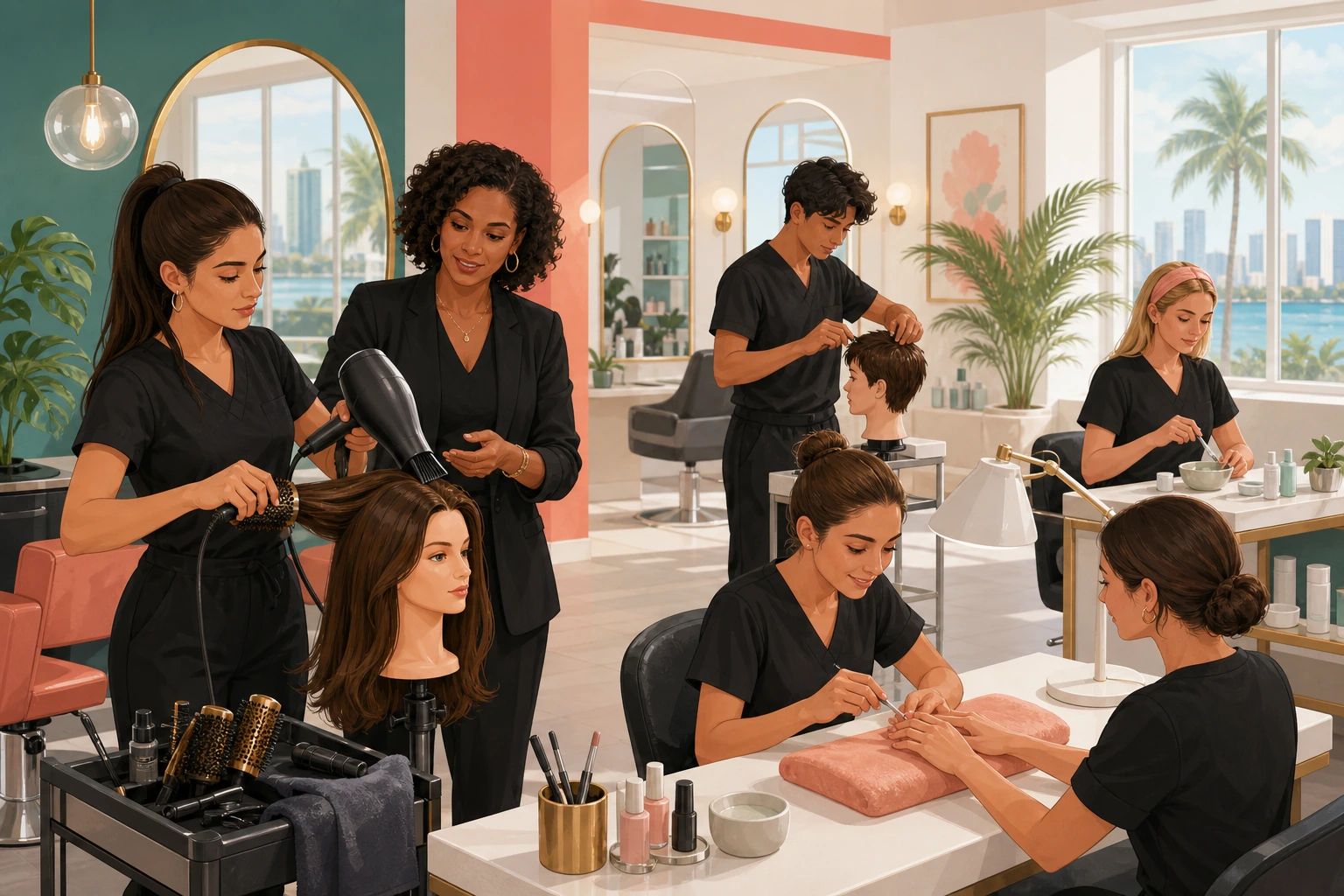
Hero image: editorial illustration generated for Of Amazing Things; it does not depict a real school, salon, or person.